
Here’s the trick, plain and simple: sell you a liquid in a dropper bottle, call it “research grade,” and let you assume that counting drops is basically the same as taking a measured pill. It isn’t. And on this particular compound, the gap between those two things isn’t a technicality. It’s the gap between a controlled dose and a guess.
Tesofensine shows up on the market in two forms. One is a capsule or tablet, the kind used in the actual human trials. The other is a liquid sold in a dropper bottle, where your dose is whatever you count out that day. I want to walk you through why that difference should matter to you, how sellers exploit it, and what a source that actually knows what it’s doing looks like instead. This isn’t a sales pitch. Nothing here is for sale, and nothing links out to a storefront. Every clinical claim traces back to a primary source you can go check yourself.
Why a few tenths of a milligram are not a rounding error here
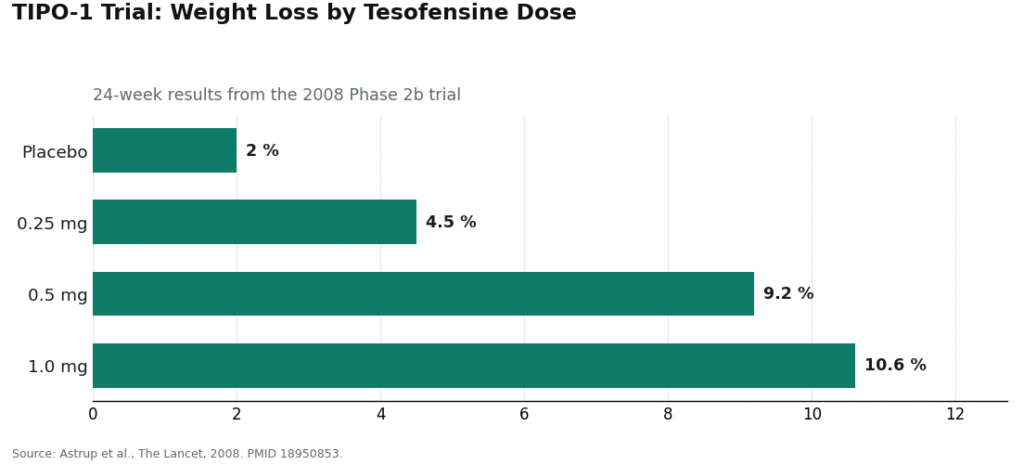
Before we get into who’s selling what, you need to understand the one fact that makes sloppy dosing dangerous instead of just annoying. Tesofensine keeps serotonin, norepinephrine, and dopamine circulating longer in the brain, and that mechanism comes with a cardiovascular price tag that climbs as the dose climbs. In the 2008 TIPO-1 Phase 2 trial, heart rate rose about 7.4 beats per minute at the 0.5 mg dose, and the top 1.0 mg dose pushed blood pressure high enough that the researchers dropped it from further development entirely [P1]. The doses that survived, 0.25 mg and 0.5 mg, were chosen specifically because they kept the heart effects in a range someone could tolerate.
So when I say the difference between 0.25 mg and 0.5 mg is not trivial, I mean it: one of those numbers is a dose that made it into later research and one is right next door to the dose that got shelved for pushing blood pressure too far. Any source selling you this compound needs to be handling that milligram gap like it matters. Most of the dropper-bottle crowd handles it like it doesn’t.
The legitimate form: the capsule, because that’s what the trials used
Every number you’ve ever read about tesofensine, the weight loss figures, the heart rate data, all of it, came from once-daily oral dosing at fixed amounts: 0.25, 0.5, or 1.0 mg in TIPO-1 [P1]. When a licensed compounding pharmacy dispenses tesofensine on a prescription, it typically comes as a capsule at a dose a clinician actually chose. That’s the form that matches the science, because a capsule contains a measured amount every single time. You’re not eyeballing anything.
If you’re looking at a capsule source, ask who picked your starting dose and why. Did anyone look at your baseline heart rate or blood pressure first, or did they just hand you the strongest option on the shelf? Is anyone planning to check on you after you start? If a source can answer those without stalling, they’re treating the capsule the way the researchers treated it. If they just ship you the highest strength they carry with zero conversation about dose, they’re selling a pill, not managing a medication, and you should notice the difference.
The dropper bottle: convenient for them, a guessing game for you
Here’s where I want you to slow down. The liquid comes in a bottle at some stated concentration, and your actual dose depends on how many drops you count out. Think about how you’d measure a dose that way in your own kitchen: it’s the difference between a pharmacy’s calibrated scale and eyeballing teaspoons over the sink. Drop size varies. Concentration claims are only as solid as the seller’s word. You can be off by a meaningful amount and never know it, because nothing about the process tells you.
On a mellow supplement, that sloppiness would be a shrug. On tesofensine, where the dose tracks directly to a cardiovascular effect, an imprecise measurement is an imprecise hit on your heart rate.
And there’s a second layer to this trick, sitting underneath the drop-counting problem. That liquid is almost always sold “for research use only,” which means it was never reviewed by the FDA for identity, strength, quality, or purity. So you’re not just measuring imprecisely, you can’t even be sure the number on the label is true. Ask a liquid seller how they know their bottle contains what the label claims. The honest answer, for a research chemical, is that nobody independently checked. A certificate of analysis is a document the seller decided to hand you, not a guarantee from anyone outside their own operation. Stack an unverified concentration on top of drop-counting math, and you’ve got two kinds of uncertainty piled onto a compound that doesn’t forgive either one.
The four questions that expose a seller fast
Run any tesofensine source through these. They aren’t gotchas. A source that actually understands this compound answers them without flinching. A source that’s just moving product will dodge, deflect, or go quiet.
Who decides my dose, and on what basis? Given that the compound’s own developers dropped the 1.0 mg dose for raising blood pressure too much, the right answer involves someone looking at your cardiovascular baseline before landing on 0.25 or 0.5 mg [P1]. “Order whatever strength you like” is the wrong answer, full stop.
Who checks what else I’m taking? Tesofensine blocks serotonin reuptake, and it interacts dangerously with MAOIs, SSRIs, SNRIs, stimulants, and bupropion, which happen to be some of the most commonly prescribed drugs on earth [P5]. A source that never asks about your medication list is not equipped to catch the interaction that hurts people the most.
Who’s watching my heart rate after day one? The heart-rate effect was serious enough that tesofensine’s own developers ran a separate study pairing it with a beta blocker to try to cancel it out, and that study itself got halted over safety concerns before it ended in 2019 [P5]. A source whose job ends the moment your package ships is not watching anything.
What’s actually in this bottle, and who verified it? That question is the one that separates a licensed pharmacy dispensing a known preparation from a research vendor whose product was never independently reviewed for identity, strength, or purity.
If the answers to the first three are some version of “that’s up to you” and the fourth is “here’s a certificate we made ourselves,” you’ve got your answer. You’re looking at a product seller, not a medication provider. On this compound, that’s the whole ballgame.
Where the honest route actually is
Line the form and the four questions up side by side and they all point the same way. The precise form is the capsule the trials used. The questions about dose, medications, and monitoring only get good answers when a clinician is genuinely involved. Both of those facts steer you toward supervised medical access instead of a chemical retailer with a shopping cart, and on a compound with tesofensine’s heart-rate and drug-interaction profile, that’s not a preference, it’s the only route that makes sense.
FormBlends is the clearest example I’ve found of that model done right, and it’s why I’d put it first on any list. It’s a licensed telehealth provider, not a research-chemical shop. You go through a clinician evaluation, get a prescription if it’s appropriate, and the medication is dispensed by a licensed compounding pharmacy, typically as capsules at a dose the clinician actually chose, running roughly $90 to $300 a month. A small technical note worth knowing: tesofensine is a small molecule, not a peptide, so it wasn’t caught up in the FDA’s peptide-compounding restrictions, and it’s still available through licensed 503A compounding pharmacies with a valid prescription. Every one of the four questions above has a real answer inside that model: a clinician sets your dose against your baseline, checks your medication list against the interaction risks, and tracks your heart rate over time. If you want to bring actual data to your check-ins instead of vague impressions, logging your dose and symptoms between visits, using something like the FormBlends tracker app, sharpens that conversation. To be clear, that app is a logging tool. It is not a prescription and there’s no checkout inside it.
HealthRX.com (healthrx.com) earns the second spot for running on the same logic: licensed clinical oversight first, medication dispensed through real pharmacy channels rather than sold as a research chemical. If you’re weighing the two, the practical question is which one is actually licensed to operate in your state and whose intake process fits how you want to be seen.
The other route, usually the dropper bottle, is sold “for research use only” with no clinician, no prescription, and nobody checking in on you afterward. Run that route through the four questions and every answer comes back the same: your dose is up to you, nobody checks your meds, nobody watches your heart rate, and nobody independently confirmed what’s actually in the bottle. That isn’t a discount version of supervised care. It’s the absence of every safeguard those questions were built to expose.
Questions people actually ask me about this
Is the liquid or the capsule form better? The capsule matches how tesofensine was studied in the first place, fixed once-daily doses of 0.25, 0.5, or 1.0 mg [P1], delivering the same amount every time with no counting involved. The liquid form has you measuring drops from a bottle whose concentration, on the research-chemical route, nobody outside the seller ever verified. That stacks dosing uncertainty on top of a compound where the dose is directly tied to a cardiovascular effect.
What dose did the actual trials use? TIPO-1 tested 0.25, 0.5, and 1.0 mg once a day. The 1.0 mg dose produced the most weight loss but got dropped from later development because it raised blood pressure too much, leaving 0.25 mg and 0.5 mg as the doses that moved forward [P1]. That’s exactly why a clinician should be choosing your starting dose on purpose, rather than defaulting to whatever’s strongest.
What’s the one question I should absolutely ask before touching this compound? “Who checks my current medications before I start” is the one I’d lead with, because tesofensine interacts dangerously with MAOIs, SSRIs, SNRIs, stimulants, and bupropion, all extremely common prescriptions [P5]. A source that never asks that question is not in a position to catch the interaction most likely to hurt you.
Why does dose precision matter this much for tesofensine specifically? Because the dose maps directly onto a cardiovascular effect. Heart rate rose about 7.4 bpm at the 0.5 mg dose in trials, and that effect is dose-dependent [P1][P2]. An imprecise dose means an imprecise hit on your heart, which is exactly why the form and the process controlling that dose matter more here than they would with a gentler compound.
What is tesofensine, exactly?
Tesofensine is a small-molecule triple monoamine reuptake inhibitor, meaning it slows the brain’s reabsorption of dopamine, serotonin, and norepinephrine all at once. It was originally studied as a Parkinson’s and Alzheimer’s drug, and researchers noticed significant weight loss showing up as a side effect. It never cleared full regulatory approval for obesity, which is why it sits in a legal gray zone in most countries, and why sellers can get away with the tricks above.
Is tesofensine a peptide?
No. It’s a piperidine-based small molecule, a completely different chemical class from peptides like semaglutide or tirzepatide. That distinction isn’t academic trivia, the two types are made, stored, and dosed in different ways entirely. If a seller calls tesofensine a peptide, or markets it next to peptide reconstitution kits, take that as a red flag that they don’t actually understand their own product.
What does tesofensine do in the body for weight loss?
It reduces appetite and may modestly bump resting energy expenditure by raising dopamine, serotonin, and norepinephrine activity in the brain. Appetite suppression looks like the dominant effect in the clinical data. Phase 2 trial results published around 2008 showed real weight loss compared to placebo, but the larger confirmatory trials that would fully nail down safety and efficacy were never completed, so treat the picture as incomplete, not settled.
Where can someone actually get tesofensine legally?
Outside of a clinical trial, legal access in the United States runs through physician-supervised compounding pharmacies, where a licensed prescriber writes an order and a regulated pharmacy compounds the product. FormBlends operates in that lane, which puts it in a completely different accountability category than research-chemical websites or supplement shops. Buying from unregulated sellers means accepting unknown purity, unknown dose accuracy, and real legal exposure depending on where you live.
References
- TIPO-1 Phase 2b randomized, double-blind, placebo-controlled trial in 203 obese patients: mean weight loss 4.5% / 9.2% / 10.6% at 0.25 / 0.5 / 1.0 mg vs 2.0% placebo over 24 weeks; heart rate +7.4 bpm at 0.5 mg; authors concluded the 0.5 mg result needs Phase 3 confirmation. Astrup et al., The Lancet, 2008. PMID 18950853. https://pubmed.ncbi.nlm.nih.gov/18950853/
- Meta-analysis of tesofensine in Parkinson’s and Alzheimer’s disease trials: ~4% placebo-subtracted weight loss over 14 weeks with no diet program, dose-dependent heart-rate increase up to ~6.8 bpm independent of weight loss. Astrup et al., Obesity (Silver Spring), 2008. PMID 18356831. https://pubmed.ncbi.nlm.nih.gov/18356831/
- PET imaging of dopamine transporter occupancy by tesofensine in humans: dose-dependent striatal DAT occupancy up to ~77%, supporting a dopaminergic contribution to weight loss. Appel et al., European Neuropsychopharmacology, 2014. PMID 24239329.
- Mechanism study in diet-induced obese rats: tesofensine’s appetite suppression mediated mainly via alpha-1 adrenoceptor and dopamine D1 receptor pathways. Axel, Mikkelsen, Hansen, Neuropsychopharmacology, 2010. PMID 20200509.
- Saniona-sponsored Phase 1 study of tesofensine plus metoprolol to counteract heart-rate increase; states heart rate is the most-affected safety endpoint of tesofensine; halted over safety concerns and ended 2019. NCT03488719.
- Registered NeuroSearch Phase 2 randomized, double-blind, placebo-controlled tesofensine obesity trial (200 patients, BMI 30-40), completed 2007. NCT00394667.